
The Pomodoro Technique seems too simple to work: pick a task, set a 25-minute timer, work, and take a break. The problem is that most people only use the timer, leave their phone on the desk, choose a vague task, and then decide they “don’t have the discipline for Pomodoro.”
A timer does not protect your attention on its own. It simply creates a visible boundary between work time and stopping time. When that boundary comes with a small task, fewer interruptions, and a real break, getting started feels less overwhelming.
The technique was created by Francesco Cirillo in the late 1980s, when he was a student using a tomato-shaped kitchen timer—pomodoro means tomato in Italian. The format popularized 25-minute focus blocks followed by 5-minute breaks, but the core idea came from experimentation, not a universal law about attention. This guide to the method’s origins and application helps explain that foundation.
What the Pomodoro Technique Solves—and What It Doesn’t
The Pomodoro Technique’s greatest benefit is not making you focus perfectly for 25 minutes. It is reducing the mental negotiation that happens before you begin. Instead of thinking, “I need to study the entire subject” or “I have to finish this report,” you make a smaller commitment: work on one defined part until the timer goes off.
That changes your relationship with big tasks. A presentation does not need to be “completed”; it can become “find sources for the first three slides.” A chapter does not need to be “studied”; it can become “read pages 12 through 18 and answer the two review questions.”
The timer also makes your effort visible. By tracking each completed cycle, you stop judging your day solely by how tired you feel and start seeing what actually fit into your attention. That kind of tracking is part of the practice described in another practical guide to Pomodoro, which recommends observing completed cycles to adjust the method to your own patterns.
There is an important limit: Pomodoro will not fix an impossible schedule, a noisy environment, or an undefined task. It also becomes less useful for work that requires prolonged immersion, such as coding a complex solution, writing when ideas are finally flowing, or analyzing a difficult problem without interruptions. In those situations, the timer can be a check-in point rather than an order to stop in the middle of productive thinking.
My verdict is simple: Pomodoro works as a system for starting, returning to, and measuring focus. It is not a magic technique, and there is no evidence that 25 minutes is the ideal interval for every person, task, or attention level. Used flexibly, though, it is far better than waiting for perfect motivation to show up.
Before You Start the Timer, Define the Deliverable
“Try to study,” “make progress on work,” and “answer emails” are not good Pomodoro tasks. They are broad categories, too large and full of hidden decisions. When your brain encounters a vague instruction, it tends to look for an easier way out—and your phone is usually ready to provide one.
Define a deliverable that fits inside the block. For studying, it might be “solve questions 1 through 3,” “review 15 flashcards,” or “make a two-page mind map.” For writing, it could be “write the first paragraph,” “list the arguments for the introduction,” or “revise only the subheadings.”
A good Pomodoro task has a visible starting point and a clear stopping point. At the end of the block, you should be able to answer whether you did what you set out to do. “Read about the topic” is vague; “read the section on photosynthesis and write down three key ideas” gives you a way to evaluate the result.
Before pressing start, remove the distractions you already know will pull you away. Close unrelated tabs, silence notifications, keep a water bottle nearby, and, if possible, leave your phone in another room. The goal is not to prove your willpower in the face of temptation; it is to avoid requiring a heroic decision every two minutes.
If you feel the urge to look something up, reply to someone, or open social media, write it down and return to the task. You might write “check Ana’s message,” “look up term X,” or “check bank balance.” This does not eliminate the impulse, but it keeps the impulse from taking over the block.
The Mistakes That Make the Pomodoro Technique Fail
Skipping the break is a common mistake because it feels productive. You finish 25 minutes, immediately start another block, and feel committed. After a while, though, your attention drops, your body gets restless, and the technique starts to feel like one more demand for constant performance.
The break is not a reward for working well. It is part of the rhythm. Stand up, drink water, look out the window, stretch your neck, or walk around the house for five minutes. The goal is to change your state, not fill the interval with more stimulation.
The second mistake is turning the break into phone scrolling. Five minutes on social media rarely stays five minutes, because the content is designed to pull your attention toward the next video, message, or update. When the timer to return goes off, you are not rested: you are mentally engaged in a different task and have to pull yourself away from it.
If you already associate every break with your phone, try a very concrete experiment. Before studying, write down a 15-minute deliverable, such as “solve questions 1 through 3” or “write the first paragraph.” Keep your phone out of reach, write down every urge to check it, and take a five-minute break without social media. Repeat this for three days and track how many blocks you complete.
Want to reduce the urge to open social media between focus blocks?
A short, gradual plan can make your phone less automatic during study and work. Take the 7-day challenge to stop scrolling on your phone.
The third mistake is treating an interruption as a total failure. Someone calls you, an important question comes up, or your mind wanders for a few seconds. Instead of declaring that “the Pomodoro was ruined,” identify what happened, write it down if necessary, and return to the next action in the task.
There is also the mistake of trying to use the same format for everything. A focus block works well for reading, reviewing, answering requests, organizing documents, and starting drafts. Meetings, customer-facing work, team conversations, and activities that require immediate responses need a different setup—perhaps reserved focus periods between windows of availability.
 Foto: Acervo pessoal/Modo Offline
How to Adapt Pomodoro If You Can’t Sustain 25 Minutes
Not being able to maintain focus for 25 minutes does not mean you have failed at the Pomodoro Technique. It means that 25 minutes, in that context, may be beyond your current attention tolerance. Insisting on the standard format just because it is famous turns a support tool into another rule to break.
Cirillo himself reportedly began his experiments with 10-minute blocks before arriving at the better-known format. That is a useful reminder that the number should not become a dogma. For someone who freezes before getting started, 10 or 15 minutes of real focus are more useful than 25 planned minutes that get abandoned.
People with ADHD—or anyone who feels restless, intensely resistant to starting, or unable to sustain long blocks—can experiment with shorter intervals without guilt. This does not replace professional support when it is needed, but it may help create a work routine that better matches the attention you have available. The goal is to build a repeatable experience of “I can start and come back,” not to beat a stopwatch.
Calibrate instead of guessing. On three different days, choose comparable tasks and test 10-, 15-, and 25-minute blocks, always followed by a five-minute break. At the end, write down four things: how easy it was to start, the number of interruptions or urges you noted, discomfort during the block, and the work you completed.
Choose the shortest duration that lets you begin without triggering an escape response. After a few days, add five minutes if the blocks are becoming too easy. The right interval is the one that produces enough work without making you associate the timer with feeling trapped.
It is also worth adapting the longer break. The traditional protocol suggests a 15- to 30-minute break after four cycles, but four 25-minute blocks may be too much for a busy morning or for someone just getting started. Take a longer break when you notice a clear drop in quality, persistent restlessness, or a real need to eat, walk, and restore your energy.
A Practical Plan for Using Pomodoro Today
Start by choosing one task with a small, verifiable deliverable. Write that deliverable on paper, not just in your head. Then choose the block length based on your reality: 10, 15, 25, or even 40 minutes for a task that is already flowing well.
Set up your environment before the timer starts. Put your phone out of reach, close anything you will not use, and keep only the necessary materials in view. If you need a computer, decide which document, website, or tab is part of the work so you do not confuse browsing with preparation.
During the block, do only the task you agreed to do. When an internal distraction appears, write it on a sheet labeled “later” and return to the next step. When an unavoidable external interruption happens, handle what is necessary and restart honestly—without using it as permission to abandon the rest of the period.
At the end, mark one completed cycle and quickly answer: What did I move forward? Where did I get stuck? What is the next action? This review takes less than a minute, but it prevents you from returning to your next work session without knowing where to pick up. Take the five-minute break afterward, preferably away from feeds, messages, and short videos.
If you are just starting out, use this plan for one week without trying to complete eight blocks per day. Two or three well-defined cycles already provide enough information to notice patterns. You may discover that you work better in the morning, that reading tasks need shorter blocks, or that your phone is your main trigger for giving up.
Frequently Asked Questions About the Pomodoro Technique
Do I need to use exactly 25 minutes for the Pomodoro Technique?
No. Twenty-five minutes is the most widely known format, but it is not mandatory. If 10 or 15 minutes help you start and complete blocks more consistently, that is a better starting point.
Can I use my phone as a Pomodoro timer?
You can, but it is not the best option if notifications, messages, or social media usually distract you. A physical timer, watch, or app locked on the timer screen lowers the chance that your focus tool becomes a gateway to distractions.
What should I do if I finish the task before the timer goes off?
Use the remaining time to review your work, organize the next step, or make a little more progress on the same task. If you repeatedly finish far ahead of time, the deliverable was too small and can be combined with a related action in the next block.
Should I stop when the timer goes off even if I’m focused?
Not always. If you are in a productive period of deep focus and can continue without sacrificing needed rest, mark the cycle as complete and extend it for a few more minutes. Just do not turn that exception into a habit of ignoring every break.
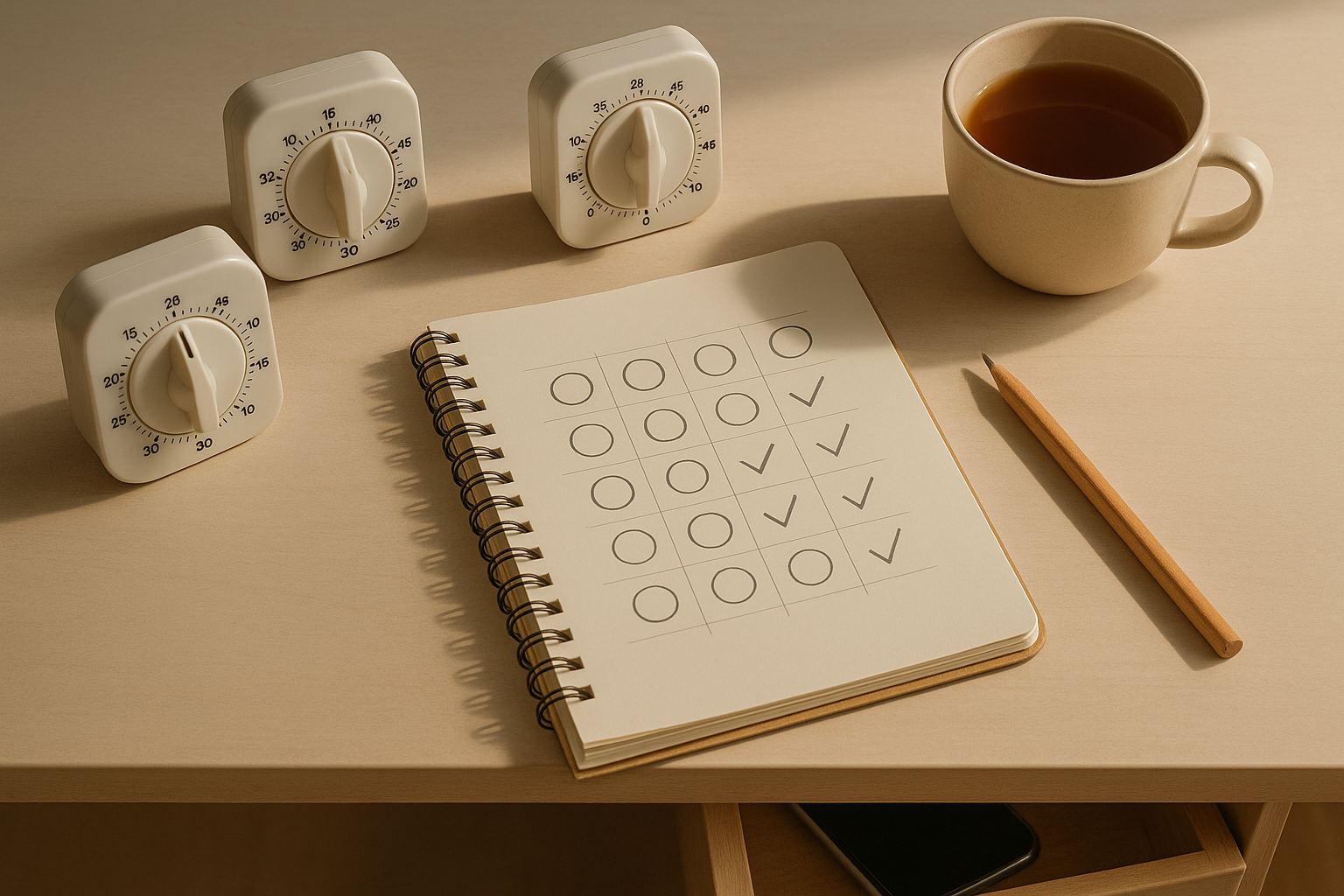 Foto: Acervo pessoal/Modo Offline
The Timer Should Serve Your Focus, Not Demand Performance
The Pomodoro Technique matters less because of the number on the clock and more because of the agreement it creates with you: a defined task, a protected period, and a break that does not steal the attention you just earned. When those elements are in place, work depends less on “feeling like it.”
Start small, track your cycles, and observe your behavior without judgment. If you abandon a block to grab your phone, do not conclude that you are incapable of focusing. Investigate whether the phone was too close, the task was too vague, or the interval was too long. Adjusting the method is part of the method.
Pomodoro does not need to take over your routine. It can simply be the structure that helps you get through the first few minutes of a difficult task, return after a distraction, and recognize that focus is not a rare talent—it is an environment and a rhythm you can build.